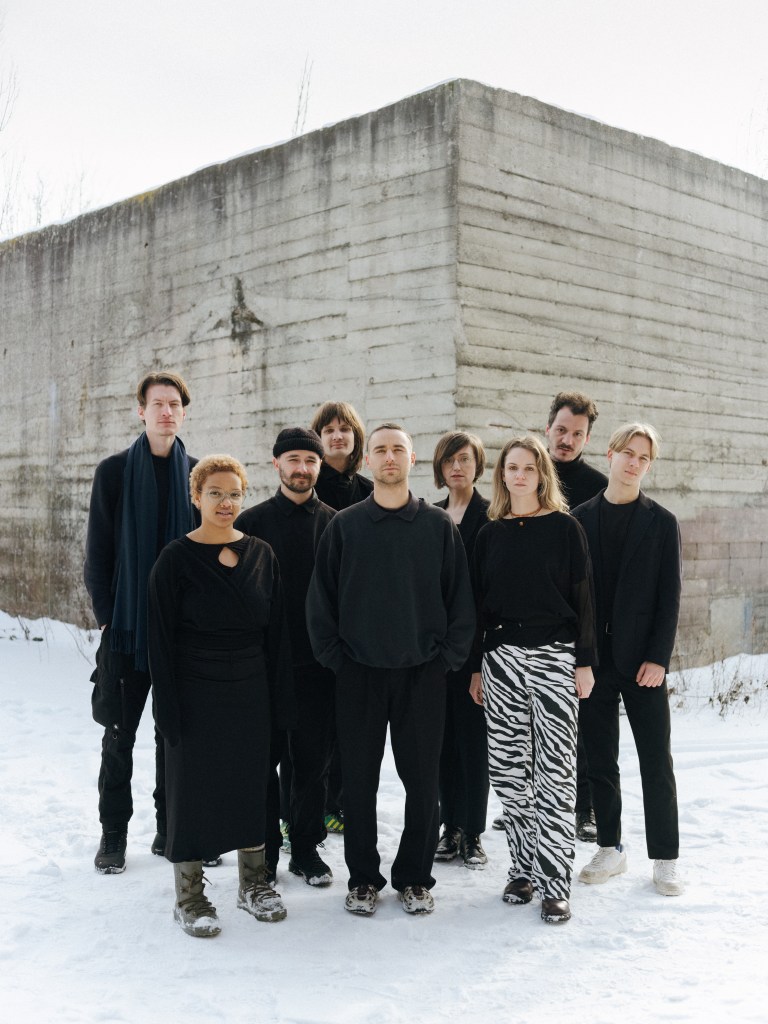
Simon Lucaciu – piano, electronics, compositions (DE)
Marina Schlagintweit – piano, electronics (DE)
Paula Bagotyriūtė – piano (LTE)
Aleksander Sever – vibraphon (NLD)
Tara Sarter – flute & saxophone (DE)
Florian Müller – doublebass (DE)
Jakob Obleser – doublebass & ebass (DE)
Samuel Dietze – drums & electronics (DE)
Philipp Ruoff – sound and electronics (DE)
Infotext in Deutsch:
Mit der außergewöhnlichen Besetzung aus drei Klavieren, Vibraphon, Flöte, zwei Bässen, Schlagzeug und elektronische Klängen entsteht ein neues musikalisches Stilverständnis: eines des Post-Genres, das kreativ Regeln neu formuliert und sich von bereits funktionierenden Strukturen und Remarketing-Ideen distanziert. Zentrale Themen der Musik sind die Mechanismen der Be- und Entschleunigung, die in der modernen Welt immer mehr an Bedeutung gewinnen. Anstelle von Überforderung und Reflexivität schafft das Ensemble einen produktiven und flexiblen Umgang mit diesen komplexen Bewegungsmechanismen.
„Wir betrachten Bewegung nicht nur als ein rhythmisches Konzept, sondern auch als ein Konzept von Freiheit.“
Darüber hinaus werden innerhalb des Ensembles Fragen nach der Gleichberechtigung der einzelnen Stimmen und deren Bewegungsmöglichkeiten gestellt.
„Wir verstehen unseren Prozess als fundamental für unser künstlerisches Handeln. Sobald sich etwas unveränderlich anfühlt, arbeiten wir bewusst dagegen oder stellen uns die Frage, wie wir dies wieder formbar machen können. Die Arbeit auf der Bühne ist nicht phasenverschoben, sondern stets synchron mit dem Prozess. Wir kritisieren den Vermarktungsgedanken, der besagt, ein „fertiges“ Produkt verkaufen zu wollen. Wir wollen unsere Arbeit, somit unseren Prozess sichtbar machen und vermitteln.“
Das Projekt ist Teil eines prozesshaften Forschens und wirft Fragen nach neuen Strukturen und Denkweisen in der Musik auf.
information text in English:
With the extraordinary instrumentation of three pianos, vibraphone, flute, two basses, drums, and electronic sounds, a new musical understanding of style emerges: one of post-genre, which creatively reformulates rules and distances itself from already functioning structures and remarketing ideas. Central themes of the music are the mechanisms of acceleration and deceleration, which are becoming increasingly important in the modern world.
Instead of creating overload and reflexivity, the ensemble creates a productive and flexible way of dealing with these complex mechanisms of movement.
“We consider movement not only as a rhythmic concept, but also as a concept of freedom.”
Furthermore, within the ensemble, questions are raised about the equality of the individual voices and their possibilities of movement.
“We understand our process as fundamental to our artistic practice. As soon as something feels unchangeable, we consciously work against it or ask ourselves how we can make it flexibel again. The work on stage is not phase-shifted, but always synchronous with the process. We criticize the marketing idea that says one should want to sell a ‘finished’ product. We want to make our work visible and communicable, which is our process.”
The project is part of a process-oriented research practice and raises questions about new structures and ways of thinking in music.

